
A System for Perfecting Daily Housekeeping Stayover Service
Daily stayover service is the job your housekeeping floor runs more than any other: every occupied room that isn't checking out, refreshed and reset while the guest is away. It runs many times a day, across a floor that is almost certainly short of the people it would like to have, and it spans more hands than it looks like — leadership building the board, attendants on the rooms, a supervisor checking the work, the PMS holding the room's true state, and the front desk blind to the guests room status. Most days it's invisible. You only notice it when a number slips, a room comes back, or a guest mentions the room "wasn't really done."
The problem is that when the floor is stretched and the team is new, speed and quality fail together — a rushed room gets marked done, nobody checks it because stayovers aren't inspected, and the miss surfaces weeks later as a quiet slide in your cleanliness scores. By the end of this post you'll have a copy-pasteable spec for the whole process — every step, every owner, every handoff — plus two portable principles you can run on any process in your hotel. The problem is a room that nobody catches until the guest does. The solution is putting the standard for "done" into the hands of whoever's in the room, and knowing which handoff let the quality slip.
The Shift That Ran Away
It's a Tuesday and Jane has eighteen stayovers on her board. That's three more than she'd carry on a good day, but two attendants are out and the rooms still have to get done, so the board is what it is. Two of the sections she's keeping half an eye on belong to hires who started this month — good people, still learning what a finished room is supposed to feel like. And the board doesn't account for the day's noise: guest requests will pull her three floors down for things that should be someone else's job, with nothing telling her in the moment what matters most, so her priorities scatter as fast as they're set.
She moves fast because she has to. The first dozen rooms go fine — beds made, baths refreshed, towels and amenities replaced, a quick vacuum, trash out. Around room ten she notices a dripping faucet, makes a mental note to flag it later, and keeps moving because there's no time to stop and call maitenence. By early afternoon she's behind her own pace, so room fourteen gets the version of the service you do when the clock is winning: bed and bath done, but the vacuuming is light and she doesn't restock the coffee because the cart's run low and the closet's two floors down.
She marks the room serviced on the floor phone and moves on — sometimes right away, sometimes a room or two later, because stopping to log each one costs minutes she's spending on the next room. Nobody checks the work; stayovers don't get inspected, there's no time and no one to do it. The room reads "done" the moment she taps the screen, whether it's done or not. Two floors over, one of the new hires is closing rooms to a standard that's still forming in her head, and those read "done" too.
The faucet never gets logged. The shift ends thirty minutes long, and the front desk has spent the afternoon looking at "occupied dirty" for rooms that were clean by two o'clock, blocking an early arrival from a room that was ready. None of that is the part that stings. The part that stings shows up two weeks later, in a meeting, when the supervisor pulls the cleanliness scores for the floor and watches the line slide. Not a cliff — a drift. There's no single room to point at, no failure to fix, just a quiet, steady dip that says the rooms haven't been holding up. By the time the number tells her, a month of guests have already slept in the rushed version. Nobody did anything wrong, exactly. The floor was short, the team was new, and there was nowhere for the pressure to go but into the rooms, where no one was looking.
The Same Shift, Quietly
Same Tuesday, same eighteen rooms, same two attendants out. Jane still has a heavy board.
But this time the work moves with her instead of against her. Her next room, its priority, and the guest's known preferences are in front of her without hunting; when she finishes one, everyone knows in the same moment she does. As she closes each room, a short checklist walks her through it — with picture examples of what a finished room is supposed to look like, the made bed, the staged amenities, the squared towels. For the new hire two floors over, that standard isn't in their head yet, but it's in their hand on every room, so their rooms close to the same finish as Jane's. The dripping faucet Jane spots becomes a work order the instant she notes it, not a memory she loses by room twelve. The front desk sees each room go ready the second it's ready, so the early arrival walks straight up.
The shift closes on time. And two weeks later, in the same meeting, the supervisor pulls the same cleanliness scores — and the line isn't sliding. Nothing dramatic happened. The rooms just held up, room after room, because the standard was in front of the person doing the work. And then nothing else happens, because a process that works is quiet.
How?
Where the Day Actually Slipped
Start with the broken shift as a picture. Watch where the arrows go dotted.
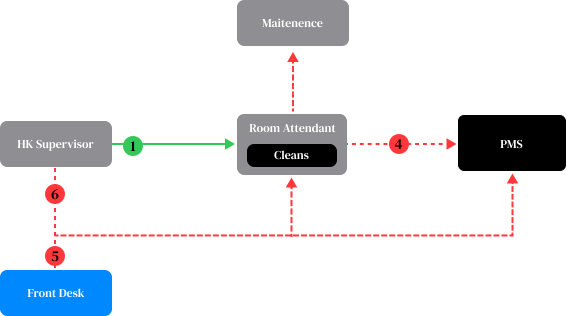
The manual run, step by step:
- Supervisor hands the attendant the board — room list, sections, priorities, VIP and special flags.
- Attendant services the room and marks it done — to whatever standard is in their head that day. Nobody checks; stayovers aren't inspected.
- A quality miss has no catch on the floor, so it surfaces later as a drifting cleanliness score, with no single room to point at.
- The attendant updates room status in the PMS manually, often a room or two late.
- The front desk sees "occupied dirty" long after the room is actually clean, and blocks an arrival that didn't need blocking.
- The supervisor has no live view of the floor, so the true state only assembles after the fact — in a scores report, weeks later.
Now name what you just felt happen to Jane. The shortage didn't break the shift on its own — it pressed on five seams that were already missing a confirmation, and those are what let the day come apart: a slower floor, a quieter quality drift, and the rest of the building working blind to what was actually happening on it.
- No Real Time Priorities. Jane’s board was heavy, and her priorities were always shifting—guest requests pulled her away from her own rooms, sending her three floors down for something that should’ve been someone else’s job. There was no system guiding what mattered most in the moment, so time was lost in the gaps, and the team’s effort scattered instead of compounding across the floor.
- No Standard at the Point of Work. The definition of a finished room lived in training and in veterans' heads — not in the hands of a new hire mid-room. With turnover high and no inspection to catch a miss, quality rode entirely on tenure the floor didn't have.
- No Live Status. The room was clean at two o'clock and nobody knew until late. You can't hand a ready room to an arrival you can't see is ready.
- No Owned Return Leg. Jane saw a dripping faucet and it died in her memory by room twelve. Nobody's job was to carry that issue off the floor and into Engineering's queue, so it never left the room.
- No Floor Visibility. Nobody was watching service time per room while it mattered, and quality only showed up as a scores report weeks after the rooms were already serviced. You can't manage a number nobody's watching in real time.
Here is the same process with those gaps closed:

The system-run flow, step by step:
- Supervisor's board goes into the system — room list, sections, priorities, VIP and special flags.
- The system hands the attendant a sequenced worklist: the next room, its priority, and the guest's known preferences.
- The attendant services the room against a close-out checklist — with picture examples of what a finished room looks like — so the standard is in hand, not just in memory.
- Any issue spotted (a dripping faucet) becomes an owned work order routed straight to Engineering — it leaves the room instead of dying in someone's head.
- The system auto-updates the room's status the moment it's closed.
- The front desk sees each room go ready live, the moment it's ready.
- The supervisor gets a live view of the floor — and service time per room — all afternoon, with the scores trend visible early enough to act on.
That's the whole difference. Put the two pictures side by side and they're nearly the same shift — the same people, the same heavy board, the same shortage. What changed is that the hotel talks to itself in real time, the standard for a finished room travels with the work instead of living in a veteran's head, and a system carries the repetitive, easily-dropped pieces — the status updates, the work-order routing, the preference lookups — that get hard exactly when you're short-handed and the team is new. The work simply stopped having a place to fall through. Nothing heroic happened. The gaps were closed.
You may not always be able to wave a magic wand and put a system in. But the map above is yours regardless, and you can run it by hand. Here is the whole process as a per-step spec — what to see, what to plan, what to act on at each step. Copy it straight into your SOPs.
| Step | Owner | Input | Output | Success metric | Direction |
|---|---|---|---|---|---|
| Plan the day & own the board | Housekeeping supervisor | Room assignment: room, status, checkout time, priority flag, prep flags | Room assignment (adds attendant, section) | Room coverage accuracy (every room accounted for), Total Cleaning Minutes / Total Staff Minutes | ↑, → |
| Dispatch the board | Housekeeping supervisor | Room assignment (adds attendant, section) | Room assignment (delivered to room attendant) | Board Distribution Time | ↓ |
| Travel to the room | Room attendant | Room assignment | Room assignment (attendant on site) | Dispatch time (assignment to room) | ↓ |
| Clean the room | Room attendant | Room assignment | Room assignment (status → occupied clean) | Room service time, Cleanliness Score | ↓, ↑ |
| Assess & log faults | Room attendant | Room assignment | Maintenence Issue: room, location, symptom, severity, photo → maintenance | Guest Issues Reported | ↓ |
| Status update | Room attendant / system | Serviced room | Room status: clean/ready, timestamp | Room status latency | ↓ |
One rule on that table: it carries a metric and a direction, never a target number. The direction is always defensible; targets are yours to set against your own floor.
Two Principles Worth Stealing
Before you go, two ideas are worth pulling out of this one process, because they hold true for every process in your hotel.
Pick One Number That Matters. Every process should have a single number that tells you whether it worked. For stayover service, that number is service time per room — how fast a room gets turned, done right. Cleanliness score and completion rate matter too, but they're not the headline; they're the clues that tell you why the time moved. If service time blows out, your quality score tells you whether you're rushing, and your completion rate tells you whether you're even finishing. Watch one number; keep the rest as clues. Twelve goals means no goal.
Watch the Handoffs, Not the Departments. The work didn't fail inside Jane's hands — she's good at her job. It failed in the gaps: between a new hire and a standard that never reached her, between the floor and an engineering queue the faucet never made it to, between housekeeping and a front desk that couldn't see what was ready. That's where a short-staffed, high-turnover shift quietly comes apart. So check every handoff in any process by asking three questions: who owns it, what gets passed, and how would you know if it dropped? Jane's drifting scores are just one tell — the work leaked at the seams, not in the rooms.
The Full Playbook
You've now got the fix for one process, free — and every process on this blog is free to read, framework and all.
If you'd rather have them all in one place, we've assembled the full guide: every operational process end to end, from check-in to check-out through checkout and post-stay, mapped the same way as this one.
And if running this many connected processes by hand — on a floor that's short of the people it needs — is starting to feel like the real problem, that's the thing we can take off your plate. We can run all of it for you.